dubiously true stories and cartoons

Tuesday, October 15, 2013

THE PAPERLESS OFFICE


 WARNING: This has nothing at all to do with the story that follows.

When I posted my last blog I put it on (as I usually do) the RAF Supplier's Past & Present page on facebook. The post, if you remember, was called A Creature of Habit and was advertised with two pairs of Converse trainers featuring Batman and Superman designs. This was because they were featured in the story. Someone, I don't know who, decided to report me to the Administrator of the page for reasons known only to him/herself.

Now, it was entirely possible that he/she reported the post because they thought that I may have been trying to sell something. If so, why not check the post out first? Maybe reading it would have convinced him/her that I wasn't trying to sell anything to anyone, but merely using the space I had to put a smile on their faces in these dark and depressing times of ours.

I would like to thank from the bottom of my heart the anonymous person who reported me to the Administrator of RAF Suppliers Past & Present. It was as a direct result of his/her cowardly action that my blog got more hits than ever before.

The picture below is of the gold reserve at Fort Knox and I am going to use this image to advertise my post on the RAF Suppliers Past & Present page. This does not mean that I am advertising a Closing Down Sale at Fort Knox and nor does it mean that I have any gold to sell myself. 

It's just a picture - and if you can't see that then you are a moron.

Regards

Steve
The Gold Reserve at Fort Knox
OK - so here we go - THE PAPERLESS OFFICE

I used to work in an office where my line manager would constantly send me emails, generally with attachments in them and most likely containing a single sentence that read: You may find something of interest in the attached document.

May find something of interest? By that rationale I could equally find something that was not of interest. You may find something of interest suggests that the sender had not actually read the attachment being sent. Perhaps a better way of wording the email would have been: You may or may not find something of interest in the attached document, so perhaps instead of reading it you would prefer to delete it as I am merely wasting your time sending it to you in the first place.

When I opened the attachment I’d more often than not find a ninety-five page document full of gobbledy-gook and management-speak that didn’t interest me at all.

I hate emails. I hate them because they are partly responsible for the lack of communication between people at work and after I had received a few of this type of email I decided that there was only one correct course of action to take and so, for a long period of time when I arrived at work in the morning my first action of the day was to delete all the emails my line manager had sent me without even opening them.

I felt an enormous sense of achievement when I did it, knowing full well that as I pressed that delete key I was achieving absolutely nothing. But it felt good to do it – in fact it felt so good that I started to randomly delete other emails that I received. After a while the urge to start work with a clean slate became so strong that I started to delete all my emails without reading a single one. For ages I didn’t open a single email; I would arrive at work and select all the emails and delete the lot without a single thought.

I’ve always had this theory that if something’s important enough someone will contact you if you haven’t done anything about it and so I sat at my desk and waited.

Nothing happened. Nobody contacted me about anything.

And that got me thinking; why stop at emails? Why not look at all the other stuff that had been littering my desk for such a long time and dispose of that? I went through the files in my in-tray and made a snap five-second decision on what I should do with each of them. Shredding them seemed like a good idea and so each day I would take a file into the Copy Room and run it through the shredder. Eventually I ran out of my own files to shred and therefore had to shred other people’s files. I came into work early to do this.

My colleague asked me if I’d seen a file of his that had disappeared, but I told him I hadn’t. At lunchtime that day he couldn’t find his daily newspaper.

The last time I’d had this much fun at work was in the summer of 1976.

I was in the RAF working as a Demands Clerk in West Germany. I was twenty-two years old and it was, without question, the most boring job I had ever done in my entire life. There were probably other jobs around that were arguably just as boring as an RAF Demands Clerk, but I couldn’t think of any at the time.

I worked alongside three other airmen with a Sergeant in charge of us and the only way of combatting the boredom was to find interesting things to do that occupied our young minds when the Sergeant was out of the office. During that hot summer of 1976 we spent the afternoons attempting to slice airborne wasps in two with steel rulers. It seemed a good idea at the time and was actually great fun until one of the guys had an allergic reaction after being stung in the neck by a particularly vindictive and persistent wasp. He was rushed to the Medical Centre and we didn’t see him at work again for six weeks. We closed the windows after that to prevent the wasps from getting in and the only time we opened them was to throw away Maria’s drinks.

Maria was employed as our tea lady. She was a short, dumpy Dutch widow with a small face who wore droopy surgical stockings and Deirdre Barlow spectacles that were far too big for her. You could tell her the worst joke in the world and she would laugh at it. Maria laughed at anything. She even laughed when I told her I was going on compassionate leave to attend my Grandmother’s funeral.

The sergeant told me that Maria laughed all the time because she was nervous.

“People who are nervous don’t laugh all the time,” I said. “People who are mad do that.”

“Now, now,” he replied. “Just remember that it takes all kinds.”

“All kinds of what? Nutters?”

At that moment, Maria came into the office, pushing her tea trolley ahead of her.

“Are you alright this morning, Maria?” the sergeant asked.

She winked at him, laughed, and handed him his tea.

Maria made the worst tea and coffee anyone had ever tasted. I have no idea what she did to it but she was able to make even the most drinkable drinks undrinkable. When OC Supply Squadron held his monthly meeting with other heads of departments they would rush through the agenda in order to bring the meeting to an end once they realised it was getting dangerously close to tea-break. After their first visit people would actively avoid the tea room and would panic at the sound of Maria’s trolley. I once found two visitors who were close to tears hiding in the toilets.

“She knows we’re in here,” whimpered one of them. “It’s only a matter of time before she finds us.”

“Do us a favour,” the other one said to me, “Pop your head out the door and see if she’s still there. If we’re lucky we might be able to make a dash for it.”

“It’s no good,” said his friend, “I can hear her trolley jingling up and down the corridor. It’s like the theme tune from Jaws!”

We never drank Maria’s tea or coffee and instead opened the window of the office and poured it on the grass outside. Several weeks had passed by when my friend called me over to the window. There was some urgency in his voice and so I moved quickly to see what the problem was.

“Look,” he said, with a disgusted expression. He pointed in the direction of the grass underneath the window where we had been pouring Maria’s drinks.

It was horrible. It was disgusting. No wonder no-one liked her drinks. Underneath the window, where our unwanted teas and coffees had been soaking into the ground was a clump of the ugliest looking toadstools I’d ever seen.

When the sergeant asked Maria how her husband had died, she just smiled and said, “Poisoned,” before leaving the room with a roar of laughter.

The sergeant looked at his tea with a mixture of horror and disgust, before pushing it away from him. “Get rid of this for me, will you Steve,” he said.

I picked up his cup and took it over to the window, where I poured it onto the toadstools below. “It takes all kinds, Sarge,” I said to him, “it takes all kinds.”

The sergeant was decent bloke who insisted on a clear desk policy if we wanted to leave early on a Friday afternoon. This could be achieved in two ways:

1.     Work really hard all week so that your desk is clear by early Friday afternoon.
2.     Piss about for most of the week until Friday afternoon, whereupon you gather up all the paperwork on your desk, place it in a large envelope and address it yourself, then put that in the internal mail so that you to receive it on Monday morning.

I chose the second option and I used it for many years. I would have still been using it if it hadn’t been for the introduction of emails, which are difficult to hide.

Unless you delete them from your inbox and your deleted items tab.

My line manager was beginning to suspect that I wasn’t doing any work. She’d seen me wandering around with a clipboard in my hand, glancing every now and again at an out-of-date form that I had attached to it. My desk was always clear and I was always in early, but that was usually to shred files I had discovered in trays in the Admin Office.

“I sent you an email last week about training design. What do think?” she asked.

“I haven’t got a clue,” I said.

“What do you mean? You have received the email?”

“Probably.”

“Probably? What do you mean probably?”

“I receive your emails but I don’t read any of them,” I told her honestly. “In fact I delete all your emails without even opening them.”

She looked at me flabbergasted. “Why?” she asked.

“Because you sit opposite me,” I said. “If you’ve got something important to say to me, say it to my face. Don’t just send an email and not say anything.”

I could tell she was about to berate me so I jumped in first, “That’s a nice dress you’re wearing. Is it new?”

“Well, yes . . . actually it is? How could you tell?”

“It’s just that I’ve never seen you in it before. Listen I’ve got to pop out for lunch – I’ll catch up with you this afternoon.”

“Oh . . . all right. See you later then,” she said, smiling at me.

As I left the office and headed for the shredder I heard her asking a colleague if she’d seen the Ryvita’s she had brought in for her lunch that day.

She was sure she’d left them in the top drawer of her desk.

Thursday, September 26, 2013

A CREATURE OF HABIT


I had a bit of a panic the other evening.


I was in something of a rush to get out of the house and therefore didn’t really pay enough attention as I was getting dressed. I’m very particular about the clothes I wear when I go out for the evening. The right pair of shorts has to selected, followed by the correct superhero T-shirt. I then have to decide which pair of Converse boots to put on – do I put my black Batman pair on tonight or should I wear the blue ones with the Superman logo on the sides?


Decisions, decisions.


However, all of this careful planning will fall by the wayside if the wrong pair of underpants is selected. A night out involving alcohol requires the correct underpants; they can’t be too tight and they can’t be too loose. If they’re too tight you end up pulling at them all night, which gives the impression that you spend far too much time playing with yourself. If they’re too loose there’s too much movement down there and you end up frequently rearranging yourself throughout the evening, which again gives the impression that much of your time is spent . . . well, you get the picture.


Anyway, as I said I dressed rather hurriedly in order to get out of the house and over to the bar. It was someone’s leaving party and there would be free food on offer. My wife had recently gone back to the UK to study Fine Art at the University of Cumbria and so I’m out here on my own and the promise of free food meant I that wouldn’t have to cook for myself.


It’s not that I can’t cook – I consider myself to be fairly proficient in the kitchen and have cooked chilli con carne, pizzas and dhal for some of my neighbours since my wife left. I’m not, say, like my neighbour whose wife is also in the UK. When he said to me the other day “Why don’t you come over for a curry tonight – I’m cooking,” what he really meant to say was “Why don’t you come over for a curry tonight. Someone cooked for it for me last month, and I took it out of the freezer this morning. If you phone me five minutes before you’re planning to arrive I’ll just pop it in the microwave and it’ll be ready for when you get here.”

  
So, I went to the leaving party and ate the free food and drank the free beer. I had no idea who was leaving and, to be perfectly honest, I didn’t really care. I knew I would have to listen to a long rambling leaving speech later in the evening, but that would be a small price to pay for the vast quantities of free food and drink I would have consumed by that time.


Drinking beer does have its drawbacks; first of all it gets you fairly inebriated and your speech will eventually become incoherent to anyone who has not been drinking as much as you. Secondly, you need to urinate at roughly fifteen minute intervals after a certain point in the evening. I try and hold off my first visit to the urinal for as long as I can because, as all men know, once you start (or break the seal, as one person accurately described it to me) that’s it; the rest of the evening is spent wanting to go for a piss so much that you end up not listening to what anyone is saying because you’re too busy concentrating on not wanting to go for a piss. I think it’s actually a proven scientific fact that in men the ratio of urine to beer over the course of an evening’s drinking is 3-1 – there’s just no stopping it once it starts flowing.


The drunker some men get the more they become critical of the female of the species. They say things like: “I don’t fancy yours,” or “She must have hit all the branches of the ugly tree on the way down,” or (my personal favourite) “I’ve never been to bed with an ugly woman, but I’ve woken up with a few”. It’s almost as if, upon downing their fifth or sixth pint, they have been magically transformed into Brad Pitt, Leonardo DeCaprio or Johnny Depp, minus their vast fortunes, extensive properties and interesting personalities.


By 9.30 I had reached the point of no return, that moment where I had an overwhelming urge to “break the seal” and so I stumbled off in the direction of the toilets. It was only when I reached my designated urinal that I realized the first of my mistakes. It was a schoolboy error, one that could have been easily rectified before I had even left the house; but in my haste to get to the free food and drink one that I had blatantly ignored – I had stupidly left the house to overindulge in alcohol wearing a pair of shorts that had a button-up fly instead of a zip.


When you’ve had too much to drink, even the simplest of tasks can transform themselves into tongue-poking efforts of concentration. Even a zip can be can be difficult, especially when trying to find the little metallic tag that allows you to open it. But buttons – compared to unzipping a fly, undoing buttons when under the influence is a positively Herculean task.


To make matters worse earlier that week I had almost sliced the end of my finger off while I was preparing onions for a dhal I was making. I had just sharpened the knife and as I brought it down on the onion it skidded off the top and buried itself into the end of my finger. Ironically the last time I had almost sliced the end of my finger off was in 1968 when I was working in a hotel kitchen chopping vegetables – although it was a carrot, and not an onion, that was the culprit that time.


Some of my blood eventually worked its way into the dhal I was making, but my neighbour thought it tasted OK – although I didn’t tell him about the blood.


Now I’m not good with blood, especially my own, and I tend to go into shock until someone qualified reassures me that I’m going to be all right. I ran my finger under the tap, trying not to look at it, and then wrapped it in toilet paper and rushed off to the Medical Centre. The medics were very helpful once they’d stopped laughing about the fact that I’d done this while attempting to cook after my wife had gone back to the UK. I tried to explain that I cooked anyway, but I don’t think any of them believed me.


Doctors and medics (as opposed to Doctor and the Medics who had a hit with a cover of Norman Greenbaum’s Spirit in the Sky in 1986) have a peculiar, almost innate sense of black comedy which they direct at their patients on fairly regular basis. 

In 2008 I had an accident involving an open door and some washing. My wife had been ironing some shirts at the time and hanging them above the door. As I ducked under the shirts I misjudged my entrance and smashed my head against the corner of the doorframe, at which point my eyebrow started to bleed profusely.


“Whatever you do,” said my wife, “do not look in the mirror.”


I looked in the mirror. 

What I saw was my face covered in blood and I immediately started to panic. My wife sighed as if she had seen all this before (which of course she had). She stopped ironing my shirts, bundled me into the car and drove me to Casualty.


When I eventually got to see a doctor he cleaned up the blood and told me that I was going to be OK and that there was no way that I was going to bleed to death, but he was going to have to close up the wound.


“Now,” he said, “you can either have stitches or I can seal it up with glue.”


“What’s the difference?” I asked, thinking that stitches would probably hurt.


“Well, if I put stitches in the scar it will eventually disappear,” he said reassuringly, “but if I use glue you’ll end up with a permanent scar that’ll make you look like a Bond villain.”


“Get that glue on me now,” I told him without a moment’s hesitation.


So, back at the party, I was stood at the urinal fumbling with my fly, trying desperately, with my inebriate’s sausage fingers, to unbutton the damn thing. It has been well documented over the ages that drunkenness makes even the simplest actions supremely difficult and if you don’t believe me try watching a drunk attempting to stroke a passing dog.


It took me at least three minutes just to get one button undone, by which time my bladder was so full I was convinced something the size of a medicine ball was pressing against my kidneys.


I was about to discover, however, that having a button-up fly was the least of my problems. As I popped open another button and plunged my hand into my shorts I discovered, to my horror the second of my mistakes; in the rush to get out of the house, I had put my underpants on inside out!


The flap on the right side of my underpants where I would usually slip my fingers in to pull my todger out was no longer there. It was now on the other side, but in my confused, drunken state I couldn’t work out what had happened. I just stood there, scooting my hand across what appeared to be a vast, endless piece of cloth, hoping to find some kind of entrance so that I could relieve myself, but after 5 minutes I was still fumbling with a glazed look on my face (and probably dribbling as well).


A bloke behind me asked if I was all right and I gave him the usual drunk’s reply of, “Nnnneeerrrraaaassssaaapher,” before I undid my belt, dropped my shorts and pulled down my underpants. 

I was at the urinal for a good five minutes with the kind of expression a man has on his face only after he’s had sex.


After I got home that night I made a mental note to check my clothing thoroughly before I went out to another party. But I knew I wouldn’t – the pull of a party with free food and booze is just too much for me.


I am, I suppose, like all men, a creature of habit.


Sunday, September 8, 2013

ART FOR ART'S SAKE


In 1996, after seeing the Cézanne exhibition at the Tate Gallery in London, my wife told me – in no uncertain terms – that she would never take me to another art exhibition as long as she lived.

Let me explain: she was very excited about the exhibition as Cézanne was one of her favourite artists. I knew a bit about the development of modern art but I wasn’t really that familiar with Cezanne’s work – in fact I’d never seen any of his pictures – or at least ones that I could remember.

I really wanted to enjoy the exhibition – honestly I did. I walked round with groups of people all ooooing and aaaahing at each picture, but all I saw were too many paintings of bowls of fruit (mainly apples and oranges) and a distinct inability to paint hands.

“These paintings are rubbish,” I said rather too loudly to my wife as we entered yet another room stuffed full of fruit-based paintings, “I used to paint this sort of stuff when I was at school – and he can’t paint hands.”

My wife glared at me for a few moments – it was the special glare that she normally used when she needed to freeze some water – before she informed me that it was Paul Cézanne (1839 – 1906) who formed the bridge between late 19th-century impressionism and the early 20th century's modernism and that if it wasn’t for him we wouldn’t have Matisse or Picasso or any of the modern art we have today.

“That’s as maybe,” I said, “but he still can’t paint hands.”

“You . . .” my wife began, before she stopped and turned away from me. She didn’t speak to me again until we walked out of the exhibition, and it was at that point that she said, “I’m never taking you to another exhibition as long as I live.”


The thing is – I’ll bet a lot of the people at that exhibition were thinking the same as me. While they were oooohing and aaaahing and proclaiming Cézanne as a genius they were probably thinking to themselves, “Look how he’s painted those hands – they’re absolutely crap.”

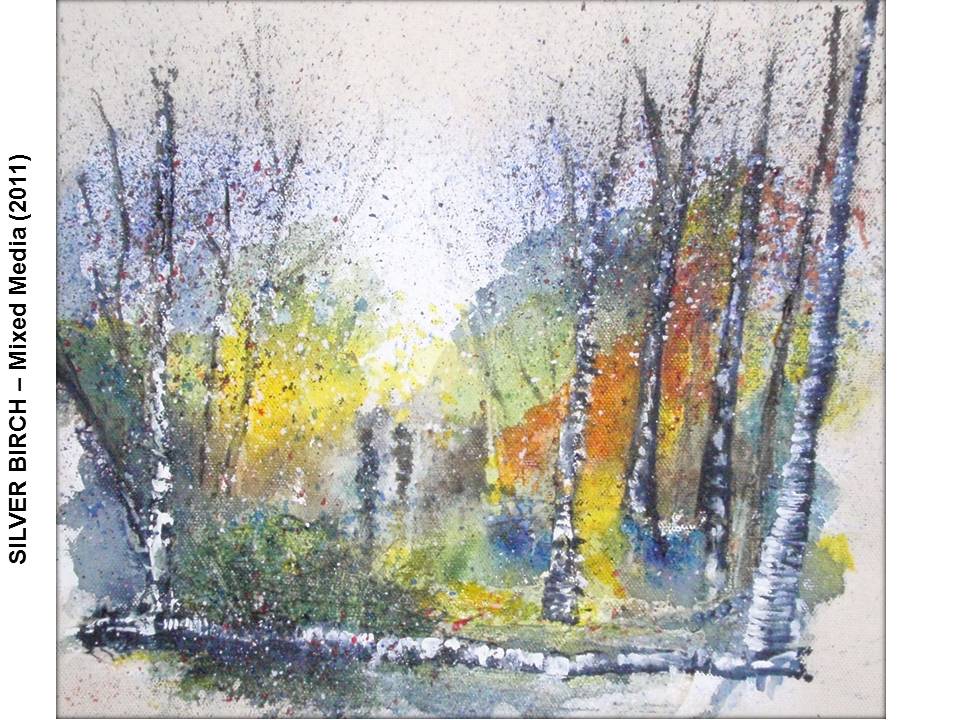
There are a lot of art snobs in the world today and before I say any more I must make it perfectly clear that my wife is not one of them. She knows what she likes and is also a very talented artist herself. In fact the pictures that are included in this article (apart from the two obvious ones) are all examples of her work.

A few years ago a television programme (I can’t remember which) carried out an experiment to expose art critics for the snobs that they were and that when they wrote their reviews they were all talking a load of utter bollocks.  

A group of kids were employed to ride their bicycles through trays of different coloured paints and then ride over canvasses that had been laid on the floor. Once the kids had finished the canvasses were left to dry and then they were framed. An exhibition space was booked and invitations were sent out to a number of art critics announcing the arrival of a major new talent in the art world. 


Champagne and canapés were served on the night of the exhibition and virtually everyone who attended oooohed and aaaahed their way around the paintings, marvelling at the skill of the unknown but obviously immensely talented artist. Some of those attending saw things in the paintings that didn’t exist. “I can see what he means here . . .” began one art critic.

One critic even bought one after it had been announced who the real artists were, which really begs the question: What is art? 

This is art.

This is NOT art.

The art critics in that programme reminded me of an English tutor I once had who tried to explain to me what Shakespeare was thinking when he was writing Hamlet. Clearly no one knew what Shakespeare was thinking except Shakespeare who was probably thinking, “Needs more sex, violence and maybe a touch of incest.

Back in 1984, way before I’d met my wife I was studying with the Open University and on the third year I foolishly decided to take a course on 17th Century Philosophy. Don’t ask me why I took that course – almost thirty years have gone by and I still don’t know why I made that ridiculous decision.

The summer school for the course was held at Bath University and on the first day there I met a guy called Mike who, like me, was a kindred spirit, a person so bewildered about why anyone would want to learn stuff about 17th Century philosophers that he suggested the only way to enjoy ourselves over the coming week was to spend as much time as possible getting pissed in the student bar and not really learning anything of any value.

Conversely all the tutors were very excited about their chosen specialist philosophers – especially Mary, a rather well-spoken middle-aged woman with large spectacles, who took us for Spinoza.

Baruch Spinoza (1632 – 1677) spent his whole life philosophising that God revealed himself in the orderly harmony of what exists, and did not concern himself with the fates and actions of human beings.


For my eighth birthday I told my grandparents that all I wanted was a budgie and a bible. On the morning of my birthday I awoke to the sound of trilling and I rushed downstairs in my blue striped pajamas to find a cage containing a yellow and green budgie. By the side of the cage, wrapped neatly in brown paper, was a bible. Like all children who want some form of living creature as a present, I quickly became bored with cleaning it out and ruthlessly left it for my grandparents to look after – it outlived both of them and was eventually taken in by my grandma’s next-door neighbour.

I opened the bible at page one and read every single word of it. It took me a year and by the time I was nine I was a committed atheist.

As an atheist I don’t believe in a God of any kind and so Spinoza’s philosophical arguments were meaningless to me.

When I told Mary this she looked at me as if I was an amoeba with learning difficulties. “What do you mean by meaningless? He's an artist, for God's sake,” she barked. It was more of a statement than a question and she may as well have tagged the words “you ignorant bastard” to the end of it.

I wasn’t overly keen on her attitude and the overprotective way she had reacted to my argument.

“Well, the way I see it,” I said, “is that Spinoza is saying two times two is four, four times four is sixteen, sixteen times sixteen is three billion two hundred thousand one hundred and forty six – therefore there is a God.”

As the word ‘God’ left my lips I noticed the expression on Mary’s face change rapidly from disdain to anger to outrage and as the neutron bomb in her head went off, she gestured to the door of the classroom and shouted, “Get out!”

I looked at her in astonishment; her face had turned bright red and the veins in her forehead were beginning to bulge out and visibly throb. I half expected her head to explode and shower me and my fellow philosophy students with the contents of her skull, but instead she clenched her hands into fists and, with her eyes welling up with tears, roared, “Get out of my classroom now, you . . . you ignorant . . . f . . . fucking philistine!”

I left the classroom before she decided to murder me and waited in the coffee shop on the campus until the session had finished. My fellow philosophy students thought the incident was highly amusing, explaining that it took Mary, with her delicate aesthetic sensibilities, a full ten minutes to recover from my unexpected full frontal assault on her beloved Spinoza.

You don't have to be that crazy to be an Open University tutor, but apparently it helps.

I’d like to point out that I’m not a philistine any more. I do actually like art and artistic endeavour, although dance of any kind still escapes me. I remember going to the ballet once and thinking, “Why?”


And of course I still think philosophy is just another word for bullshitting.

My wife does now take me to exhibitions because she has shown me how to look at art in a different way – she has instructed me on how to behave at exhibitions when I don’t appreciate what I’m looking at and she even taught me the correct words to say when I think the artwork in front of me is a pile of old shit.

A couple of years ago we went to an art exhibition at the British Trade Officer’s residence in Al-Khobar. There were several artists exhibiting their work that week and there was some fine work on display, particularly from the Saudi artists. One artist’s work, however, was not at all to my taste. It wasn’t that her paintings were badly executed – it was just that they were so twee that they made me feel physically ill. The artist was in attendance and talking to one of the dignitaries on the other side of the room, when I saw a woman looking at one of her pieces that I particularly disliked. I sauntered casually over to the woman and as I looked at the painting with her I was about to say, “This is a pile of old shit, isn’t it.”

Luckily the only word that had left my lips was, “This . . .” when I felt a cold shiver run down my spine. I looked to my left and saw my wife, who was in a nearby group of friends, using her special glare on me. I immediately recalled her training and said, “. . . is a very interesting work. Do you see the way the artist uses a combination of blues and yellows to create the illusion of light?”

“Yes,” said the woman. “It’s lovely, isn’t it? My friend over there painted it and I’ve just bought it.”

“Lucky you,” I said, before moving away and blending in with the other guests.


“And what did you learn from that experience,” my wife asked me later that evening.

“That different people like different things, and that what I may think is a pile old shit, somebody else may incorrectly think is beautiful.”

“That’s right,” said my wife. “Well done.”

And so, as the great Spike Milligan once wrote: Beauty is in the eye of the beholder – Get it out with Optrex.”